
A party that has found its voice again
This year’s Labour Conference ran under the slogan “Hope Again” and, cautiously, it felt like a reflection of the atmosphere surrounding the Liverpool docks. Around 20,000 delegates descended for five days of networking, policy debate & discussion and voting – and the mood was far more upbeat than it was a year ago.
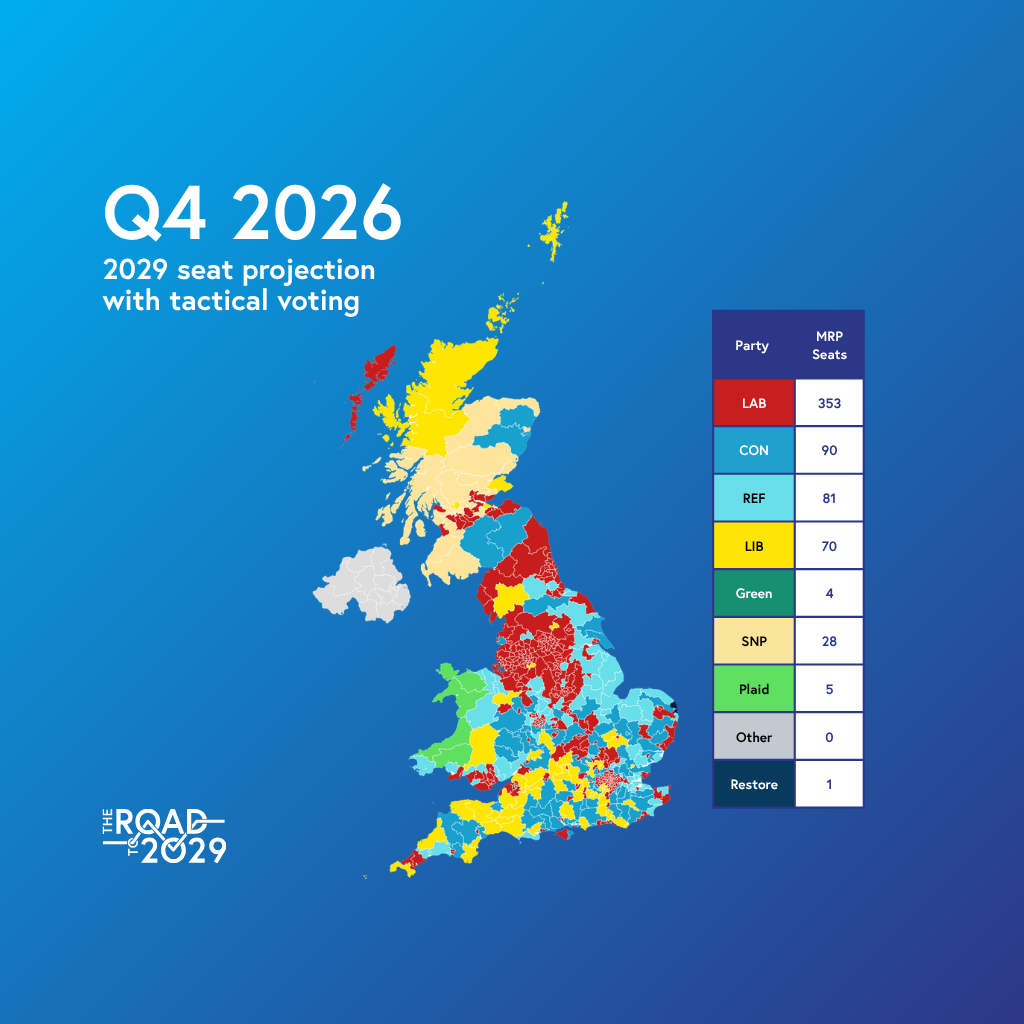
The party appears to be regrouping behind its new leader. The ‘Burnham Bounce’ is becoming a longer-term trend rather than a simple, immediate reaction to a change of leadership. PLMR’s Road to 2029 polling, in partnership with Electoral Calculus shows Labour steadily opening a gap on its opposition among voters. For a party that spent much of the last year looking over its shoulder, that matters.
The question is whether the renewed confidence can be turned into a credible programme of government and a longer-term recapturing of public support.
Grasping the nettles
Burnham’s speech showed he isn’t afraid to tackle the thorny issues that dogged previous Labour (and other party) leaders. He acknowledged he is the country’s seventh Prime Minister in a decade and leaned into the scale of the challenge rather than away from it. Unsurprisingly, devolution was at the core of his answer, with plans to give councils and mayors more power over housing, health and education.
- The triple lock. The most striking announcement was on the pensions triple lock. Burnham stopped short of scrapping the triple lock, but from April 2030 the state pension would rise by the higher of inflation or 2.5 per cent, removing the link to earnings. He framed it as a way to free up significant savings for the NHS. He also promised that low-income pensioners won’t be dragged into income tax this Parliament, though he didn’t say how.
- A National Care Service. Those savings would help fund a universal, NHS-style care service, free at the point of use and designed to provide support in people’s homes before their needs reach crisis point. It was the emotional heart of the speech, with Burnham paying tribute to his late father. It’s also the most expensive promise he made, and the triple lock change alone is unlikely to pay for it.
- Housing. Burnham reiterated his pledge to end rough sleeping and confirmed that Right to Buy will no longer apply to newly built social homes, so they stay in the public stock for future generations. Councils will get new powers to take over empty properties and to act against landlords who fail to maintain their homes, potentially bringing the worst properties into public ownership.
- Water. Burnham played to his audience in the hall, announcing a new Bill to repeal Thatcher’s ban on public ownership of water companies, which the PM described as the start of a ten-year journey. Mayors would gain powers to hold companies to account, bonus loopholes would be closed, and persistent failures could ultimately lead to public ownership. Notably, he pitched all of this as pro-business: and claimed that private owners that serve the public interest have nothing to fear.
- Energy. VAT came off household electricity bills on 1 October, one of his first decisions as Prime Minister. He also announced a publicly owned Great British Grid and a locally democratic National Energy Plan, while maintaining a pragmatic position on North Sea oil alongside a faster transition to clean energy.
- Electoral reform. Labour will go into the next election with a manifesto commitment to change the voting system, starting with a national commission. Burnham sold it partly as a stability-play for the markets. What system he actually wants, and how he builds cross-party consensus, remains unclear.
- Brexit. Burnham went further than any recent Labour leader, saying that “Brexit has done more harm than good”, and argued that it has weakened Britain’s control over both the economy and immigration. He highlighted the UK-EU summit as an opportunity to set out the options for Britain’s long-term relationship with the EU, and try to build consensus around one of them.
- Education. This subject got less airtime and less substance, with the sector largely waiting on the Milburn Review and further reforms to the SEND system due later this year.
Away from Burnham’s speech, the policy announcements were few. Councils will be able to take over homes left empty for six months rather than two years, aimed at the 300,000 empty homes in England. First-time buyers will get a new Help to Buy-style scheme, “Your first home”, with a 20% loan on new builds. Industry got £6bn of contracts for British shipyards. On defence, there was talk of spending more, but no new money.
The more telling message came from the Chancellor. John Healey refused to give any hints about the Budget, put fiscal discipline at the centre of everything, and warned members that the money New Labour had in the 1990s simply isn’t there now. While the Prime Minister set out the destination, his Chancellor was quietly warning about the cost of getting there.
Good politics
Labour’s recent by-election victory in Holborn and St Pancras further underlines the support behind Burnham. After losing Gorton and Denton to the Greens in February, Labour comfortably held off Zack Polanski in Starmer’s old seat, a sign that Burnham can stop the bleed of left-leaning voters. Add the steady polling lead over Reform and the standing ovations in the hall, and it’s easy to see why members left Liverpool in good spirits.
The common theme in the announcements is the everyday. VAT off energy bills, social homes that stay social, landlords made to fix the damp, water bosses denied their bonuses, care that comes to your front door. These are offers ordinary families can feel, and they’re great for the headlines and the polls.
There’s a strategic logic too. Burnham is trying to make public ownership sound like a practical response to failure rather than an ideological objective. His approach to electoral reform is similarly framed around stability, an argument intended to reassure business as well as Labour supporters.
…but is it good policy?
Good politics does not automatically make good policy. The first real test of this looms large at the end of the month, and the gap between the scale of Burnham’s ambitions and the detail on how to deliver them is hard to ignore.
Government spending is the obvious pressure point. The triple lock savings won’t arrive until 2030, while the VAT cut is already costing money and a universal care service will need far more than pension reform can supply. With fiscal headroom shrinking, tough decisions lie ahead, and the speech left plenty of room to read a tax rise between the lines.
The bond markets were nervous about Burnham before he even won Makerfield, and they wobbled again the morning after his victory. Since then, the cost of government borrowing has shot up, though mostly because of turmoil in global markets rather than anything Burnham has said. But the new announcements are a lot for investors to price at once, from expansive spending commitments to a ten-year path towards public water and a promise to rewrite the electoral system. Either way, he’s left with much less money to play with. Burnham clearly knows this, hence the repeated pro-business framing, but warm words in a conference hall won’t be enough on their own.
So, the questions for the Budget are simple to ask and hard to answer. What does Burnham prioritise when he can’t fund everything? Where does the money for the care service actually come from? And how will the markets react when the numbers are finally on the table?
Hope, with conditions
Labour left Liverpool more united, more confident and further ahead in the polls than it has been in a long time. Burnham has shown he’s willing to take on issues his predecessors ducked, and the party has rallied behind him.
But hope is the easy part. Many of the biggest commitments, from social care to water utilities to electoral reform, still depend on future legislation, reviews and, above all, money. The end of the month will tell us whether “Hope Again” was a conference slogan or the start of a governing programme.